
Asbestos Drywall Removal Birmingham & Montgomery AL
If your home or building went up before the early 1980s, the walls and ceilings around you may not be what you think they are. Asbestos drywall removal is one of the most common — and most misunderstood — abatement jobs in central Alabama, and it catches homeowners off guard for a simple reason: the asbestos usually isn't in the drywall panel itself. It's in the mud.
Bio-One handles asbestos sheetrock removal, popcorn ceiling removal, and full-scale drywall demolition for property owners across Birmingham, Montgomery, Tuscaloosa, Auburn, Opelika, Prattville, Hoover, Bessemer, Northport, and the surrounding communities. Here's what the work actually involves.
Why Drywall Is an Asbestos Problem in Older Alabama Homes
Three drywall-system materials are the usual suspects:
Joint compound (drywall mud). Chrysotile asbestos was standard in most industrial and consumer drywall accessory products through the 1970s. The Consumer Product Safety Commission banned consumer patching compounds containing respirable free-form asbestos in December 1977, but existing inventory was never recalled — contractors kept using what was already on the shelf into the early 1980s. Any drywall finishing work done before roughly 1982 should be treated as suspect until a lab says otherwise.
Popcorn (acoustic) ceiling texture. The EPA banned spray-applied asbestos surfacing materials in 1973, yet popcorn texture kept going up in homes well past that date using stockpiled and non-spray products. Pre-1986 texture is the standard cutoff for "test it first."
Textured wall finishes and skim coats. Same compound, same risk, applied over a broader surface.
Intact drywall sitting quietly on your wall is generally low risk. The danger is created by the work itself. Sanding joint compound is one of the dustiest activities in all of remodeling — and if that compound contains asbestos, every pass of the sanding pole is putting microscopic fibers into the air you breathe. Scraping a popcorn ceiling is worse, because you're working overhead and the debris rains down through your breathing zone.
You cannot tell by looking. Asbestos-containing compound is visually identical to modern compound. The only answer is laboratory analysis of a representative sample that captures both the seam and the texture.
The Three Jobs We Get Called For
1. Popcorn Ceiling Removal
The most common request we get in Birmingham and Montgomery. Homeowners updating a 1960s or '70s house want the texture gone before they list or renovate. We test first, then either abate under full containment or hand it off as ordinary texture scraping if the lab comes back clean.
2. Asbestos Joint Compound Removal
Trickier than a ceiling, because the compound runs along every seam and corner bead in the room. Depending on the scope, the right answer may be seam-by-seam removal or taking down the entire wall assembly — the second option is frequently cheaper and always cleaner.
3. Full-Scale Drywall and Sheetrock Removal
Gut renovations, fire and water losses, hoarding cleanouts, commercial build-outs, and pre-demolition work. When an entire structure's wall and ceiling system is coming out, the whole thing gets treated as regulated material and handled under containment.
How Bio-One Does Asbestos Drywall Removal the Right Way
Proper abatement is not a demo crew with dust masks. Our process:
- Testing and scope. Samples to an accredited lab. Material over 1% asbestos by weight is asbestos-containing material and gets handled accordingly.
- Notification. Alabama requires a 10-working-day notification to the appropriate agency before disturbing regulated asbestos-containing material on a renovation involving at least 260 linear feet, 160 square feet, or 35 cubic feet — and before any demolition, with or without ACM present.
- Containment. Critical barriers, sealed poly enclosure, and negative air pressure with HEPA-filtered air scrubbers so fibers can't migrate into the rest of the building.
- Wet removal. Amended water keeps material saturated. Wet material doesn't aerosolize.
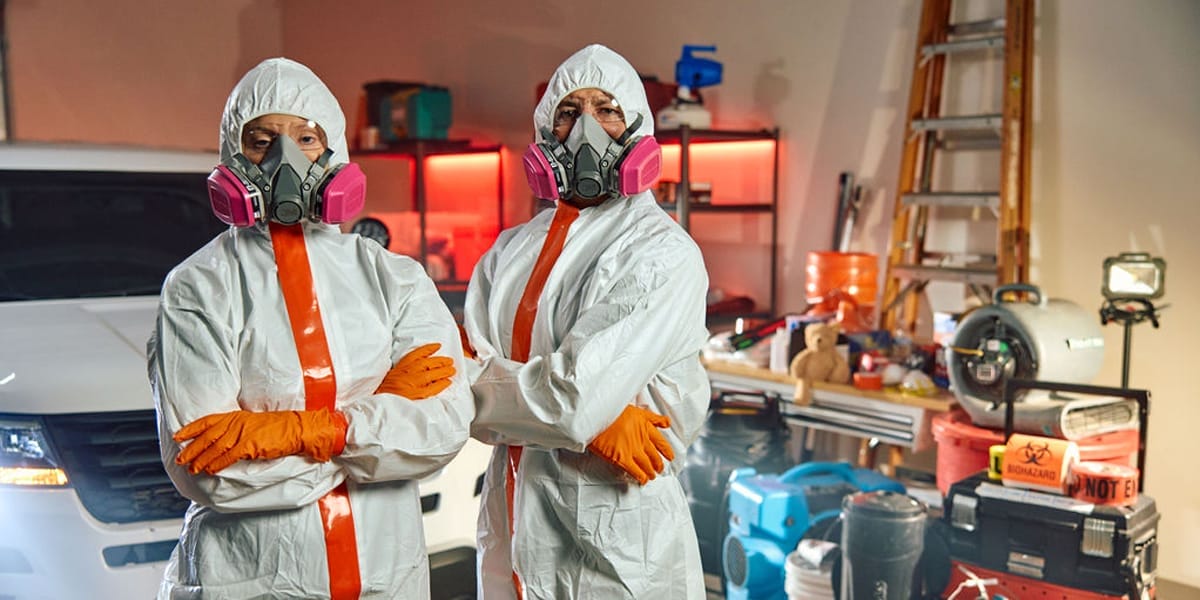
- Respiratory protection and decon. Full PPE and proper decontamination for every technician on site.
- Disposal. Double-bagged, labeled, manifested, and taken to a facility permitted to accept asbestos waste.
- Clearance. Final visual inspection and air clearance testing before the containment comes down and the space goes back to you.
The Alabama Rule Most Homeowners Don't Know
Here is a detail worth understanding before you pick up a scraper: privately owned residential buildings of four units or fewer that remain residential property are exempt from Alabama's asbestos abatement regulations — though disposal regulations still apply.
Read that again. It is legal, in many cases, for an Alabama homeowner to tear out their own asbestos popcorn ceiling. ADEM's own paperwork flags the obvious problem with that exemption: it puts homeowners at risk. The regulation stops applying at your front door. The disease process does not. Mesothelioma and asbestosis have latency periods measured in decades, and a single weekend of dry-scraping a ceiling is exactly the kind of exposure that shows up thirty years later.
Commercial buildings, apartment complexes over four units, schools, and any structure headed for demolition don't get the exemption. That work must be performed by a contractor certified by the Alabama Department of Environmental Management.
Cost to Remove Asbestos Joint Compound and Popcorn Ceilings
The honest answer is that pricing depends on square footage, ceiling height, whether the texture has been painted, access, and how much of the structure is involved. But national 2026 figures give you a reasonable starting frame:
- Asbestos testing: roughly $250 to $850 for sampling and lab analysis
- Licensed abatement: roughly $5 to $20 per square foot, with typical single-family work landing in the middle of that range
- Reskim, texture, and paint afterward: roughly $1 to $3 per square foot — this is ordinary drywall and painting work, not abatement, and happens after the containment is released
For comparison, scraping non-asbestos popcorn texture runs about $1 to $3 per square foot. That gap is the entire reason a $60 lab test is worth doing before anyone touches the ceiling: testing tells you which job you actually have. Bids that come in well under the abatement range on regulated material usually mean a corner is being cut on containment, disposal, or notification — and you inherit that liability along with the invoice.
Local pricing in Alabama generally runs below coastal-metro numbers. Get a written, itemized estimate for your specific property.
Frequently Asked Questions
Does drywall itself contain asbestos? Usually not. The joint compound, texture, and skim coat are where asbestos is typically found. Some older wallboard did contain it, which is why samples should capture the full assembly.
Can I just paint or drywall over an asbestos popcorn ceiling? Encapsulation — covering intact material rather than removing it — is a legitimate option in some cases, and often the less expensive one. It depends on the texture's condition and your renovation plans. We'll tell you honestly when it's the better call.
How long does asbestos drywall removal take? A single room is often a one- to two-day job including setup and clearance. Whole-house or commercial projects run longer.
Do you handle the disposal paperwork? Yes. Manifests, notifications, and disposal documentation are part of the job.
Serving Central Alabama
Bio-One serves Birmingham, Montgomery, Tuscaloosa, Auburn, Opelika, Prattville, Wetumpka, Millbrook, Hoover, Vestavia Hills, Bessemer, Northport, Alexander City, Selma, and the surrounding communities.
We're best known for the calls nobody wants to make — biohazard cleanup, trauma scenes, hoarding, and unattended deaths. That work built the discipline this work requires: containment, documentation, and respect for a property that is somebody's home.
If you're planning a renovation, buying an older property, or staring at a popcorn ceiling and wondering what's in it, call before you scrape.
334-523-9191 | info@bioonemontgomery.com | www.bioonemontgomery.com